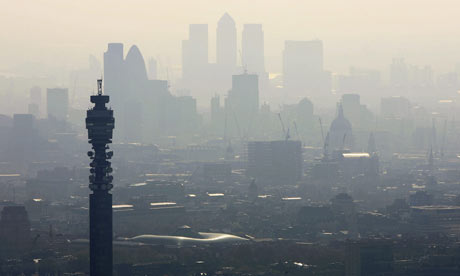
Nitrogen dioxide (NO2) levels are dangerously high in 16 regions of Britain, exceeding the EU limit which member nations were supposed to have complied with by 2010. Britain is the only nation not to apply for a time extension having failed to meet its 2010 deadline, because the Coalition has decided to fight European air regulations in court while lobbying to have them weakened.
The case comes just weeks after a World Health Organisation review found that exposure to nitrogen dioxide is harmful at even lower levels than the limits currently set by Europe.
Air pollution is estimated to cause 29,000 premature deaths each year in the UK at an average loss of life of 11.5 years. Nitrogen dioxide is one of the pollutants known to contribute to this figure, with links to conditions such as asthma and chronic obstructive pulmonary disease.
London has the highest recorded level of NO2 of any capital city in Europe. Mean levels of the toxic gas are not supposed to exceed 40 cubic micrograms over a calendar year, but some of London’s busiest roads are routinely at triple this level.
The Department for Environment and Rural Affairs will argue on Thursday that it is not possible to comply with European limits by 2015, so there was no point asking for an extension to the 2010 deadline. Instead they have made plans that mean most regions (including Manchester, Birmingham, and Glasgow) will not achieve legal limits for NO2 until 2020, and in the case of London, 2025.
Alan Andrews, lawyer at Client Earth, the campaigning law firm which has brought the lawsuit said: “The science is getting stronger, but the Government’s response is as weak as ever. We know that the higher the levels of nitrogen dioxide, the more people die, and the more people are made sick. So the fact that the Government’s plans won’t achieve compliance with air quality standards until 2025 is nothing short of a disgrace.”
“This Government thinks that laws that are in place to save lives are “red tape”. That’s why they are refusing to act to tackle air pollution, while at the same time lobbying the EU to get the laws weakened. They are on the wrong side of the science, and they are on the wrong side of the law. We need the Supreme Court to step in and force the Government to live up to its legal and moral duty to protect us from air pollution”
Last year the Court of Appeal refused to force Defra to obey EU law and the issue was passed up to the Supreme Court. Though the Court of Appeal said enforcement of the law was up the European Commission, the commission says it has “considerable concerns” about any attempts to circumnavigate their deadlines using a technicality that Defra is expected to argue in court.
Frank Kelly, professor of environmental health at King’s College London, said: “There’s a public health problem here and the Government need to take responsibility. It’s not good enough to say that we can wait to 2025.”
A spokeswoman said Defra plans to reduce NO2 levels in the “shortest possible time,” adding: “Our air quality has improved significantly in recent decades and most of the UK meets EU air quality limits for all pollutants.”
Case studies: 'I can't go down the road now because it's too polluted'
Francis Davidson, 69, lives in North London and believes her health has been directly affected by levels of air pollution there.
“I live just off the Holloway Road, which has to be one of the worst polluted parts of London - there are lorries coming by all the time. My lung collapses regularly and I can’t go down the road now because it’s too polluted. I can’t breathe when I go out and I have to time it carefully for times when there’s less traffic, like one o’clock in the afternoon.
Unless they do something about it we’re all going to get terrible lung diseases. Children are coughing their heads off and I don’t understand why nothing’s being done. I remember the smog in the Fifties which made them pass the clean air act, because it was obvious fires were making people really sick. They need another clean air act now because the air is not clean anymore.”
Fiona Dawson, 35, from East London is concerned that her eldest daughter, Maya, 3, suffers from asthma symptoms because of pollution.
“I’ve become more aware of air pollution since my daughter has had chest problems. She had her first wheezy episode a year ago and it was really frightening. We’ve been back and forth at the doctors’ and hospitals since then. The doctor said ‘ah yes, we’ve had a lot of people coming in with similar conditions because of the weather and the rise in air pollution’. It makes me very angry that more isn’t being done. Maya will be 16 in 2025 - that’s a whole generation exposed to this and the Government just don’t seem to care at all.”
Source: The Independent

